The case of Vredestein & Hammer Market Intelligence
Turning millions of online conversations into actionable competitive brand intelligence
The challenge: understanding your brand beyond traditional market research
In today's digital marketplace, consumers continuously share their opinions online. Whether discussing product performance on specialist forums, comparing brands on social media, or writing reviews after purchase, these conversations collectively shape brand reputation and influence future buying decisions.
For manufacturers, this creates both an opportunity and a challenge. While enormous amounts of consumer feedback are publicly available, extracting meaningful insights from millions of unstructured conversations is far from straightforward.
Traditional market research (e.g., using web surveys) captures only a fraction of consumer opinions and may lack the scale, speed and competitive context needed for strategic decision-making. The question then becomes: which method is suited to objectively measure brand awareness and brand perception across an entire competitive landscape?
The case: Vredestein
Vredestein is a premium tire manufacturer with more than a century of experience in developing high-performance tires for passenger cars, agricultural equipment, and bicycles. Known for its focus on safety, innovation and European craftsmanship, the company competes in a market where consumer trust and product reputation play a decisive role.
To strengthen its market position, Vredestein wanted to better understand how consumers perceive its brand relative to key competitors. More specifically, the company wanted answers to questions such as:
· How well is Vredestein known compared to competing tire brands?
· Which product characteristics do consumers associate with Vredestein?
· On which attributes does the brand outperform competitors?
· Where do competitors hold stronger positions in consumers' minds?
Rather than relying solely on surveys, Vredestein wanted to leverage the vast amount of authentic consumer discussions already available online.
The approach: How Hammer transforms online conversations into competitive intelligence
Hammer's team of data scientists and market analysts specializes in turning large volumes of unstructured information into clear, actionable market insights through its Brand Tracking & Monitoring solution. Combining advanced AI techniques with market intelligence expertise, we developed a scalable framework to measure both brand awareness and brand perception.
To uncover authentic consumer sentiment, we built a scalable analytics tool integrating both data collection and advanced text classification. Our approach to tackle Vredestein’s questions comprised of a five-step process:
1. Scraping consumer conversations at scale
We built an automated data pipeline, scraping publicly available discussions from forums, enthusiast communities and other online platforms. In addition we leveraged Hammer's own news and content database (Goldmine) to complement these data points.
In total, more than 2.8 million text items were collected across multiple countries, vehicle segments, and online sources.
2. Measuring brand awareness
Instead of asking consumers which brands they know (e.g., using web surveys), we measured which brands people naturally discuss online. This is valuable information, because the users willingly posted about the companies we researched. Using fuzzy keyword recognition, every conversation was classified according to the brand being discussed.
This created a reliable proxy for brand awareness by comparing the relative frequency of conversations about each company across millions of data points.
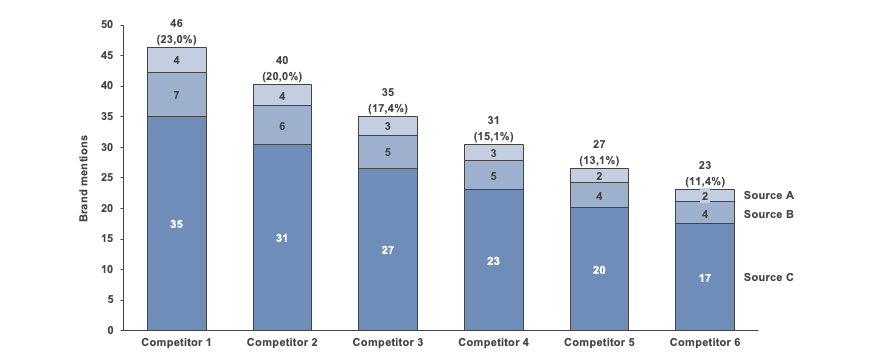
Figure 1. Example brand awareness measurement
3. Understanding brand perception using sentiment analysis
Measuring the frequency of brand mentions alone provides limited insight into brand perception. Therefore, every paragraph mentioning a brand was automatically classified using sentiment analysis.
Each conversation was categorized as positive, neutral or negative. Ultimately, providing an objective comparison of how favorably each brand is discussed within the market.
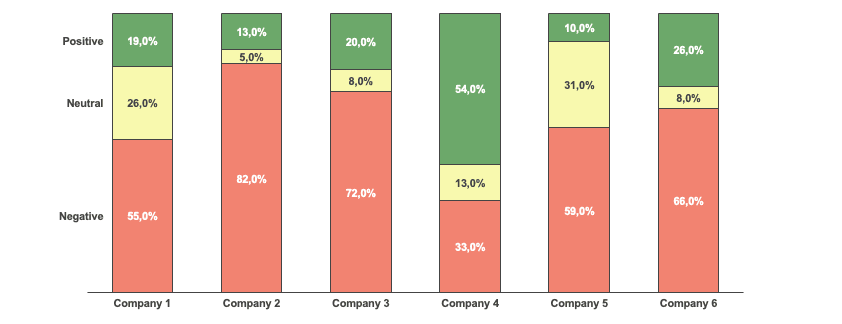
Figure 2. Example brand perception visualization
4. Identifying what drives sentiment
To identify insights beyond overall sentiment scores, we also used AI models to categorize discussions into specific product topics, including:
- Comfort & handling
- Durability
- Safety & reliability
- Value for money
- Performance under specific conditions, such as winter driving
By combining topic recognition with sentiment analysis, Hammer identified which product characteristics drive positive and negative perceptions for every competing brand. This enabled insights such as: Which brands are most associated with premium comfort? Which are perceived as best value? Who leads on safety?
These insights helped Vredestein to not only understand how consumers feel about each competing brand, but also why.
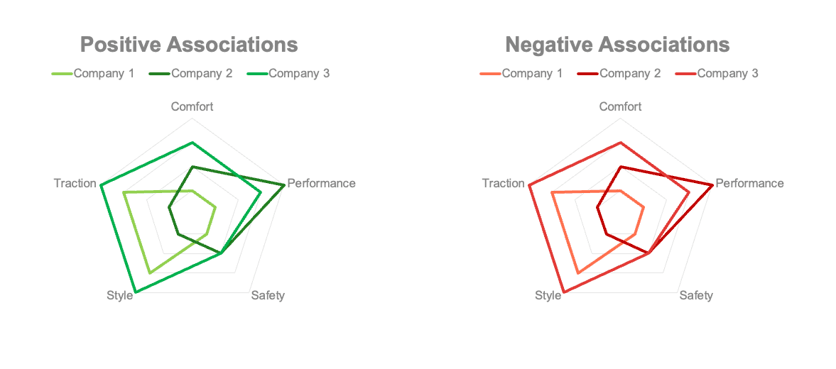
Figure 3. Example brand associations
5. Building a foundation for repeatable competitive monitoring
The deliverable was more than a one-off analysis. As scraping, measuring brand awareness, sentiment analysis and topic categorization are fully automated, the result is a pipeline that can be re-run rather than a single snapshot. While the engagement concluded at this stage, the pipeline was built with continuous monitoring in mind — providing a ready foundation that could be extended into a dashboard for periodic updates, enabling ongoing tracking of changes in market perception, evaluation of marketing campaign impact, and monitoring of competitor developments over time.
The method: scalable brand monitoring
This case illustrates how AI and market intelligence complement each other. AI enables the processing of millions of consumer conversations at a scale impossible through manual analysis. Followingly, Hammer's market intelligence expertise ensures the collected data points are translated into business-relevant insights that support strategic decision-making.
Although developed for the tire industry, the methodology is applicable across virtually any consumer or B2B market where online discussions influence purchasing behavior. Whether companies want to benchmark their brand, monitor competitors, or understand changing customer needs, large-scale sentiment and topic analysis offers a powerful alternative to traditional market research.
For Hammer, this project demonstrates how unstructured online data can be transformed into competitive brand intelligence. Looking to understand how your customers really perceive your brand? We'd be happy to discuss how this methodology can be applied to your market. Reach us at +31 85 3332472 or freek@hammer-intel.com
Turning millions of online conversations into actionable competitive brand intelligence

From strategic decisions to actionable target lists: the case of Big Chemistry & Hammer Market Intelligence