Article
Hammer ProductPulse | Understand your customers’ markets, product by product

Freek Hens
Data Scientist
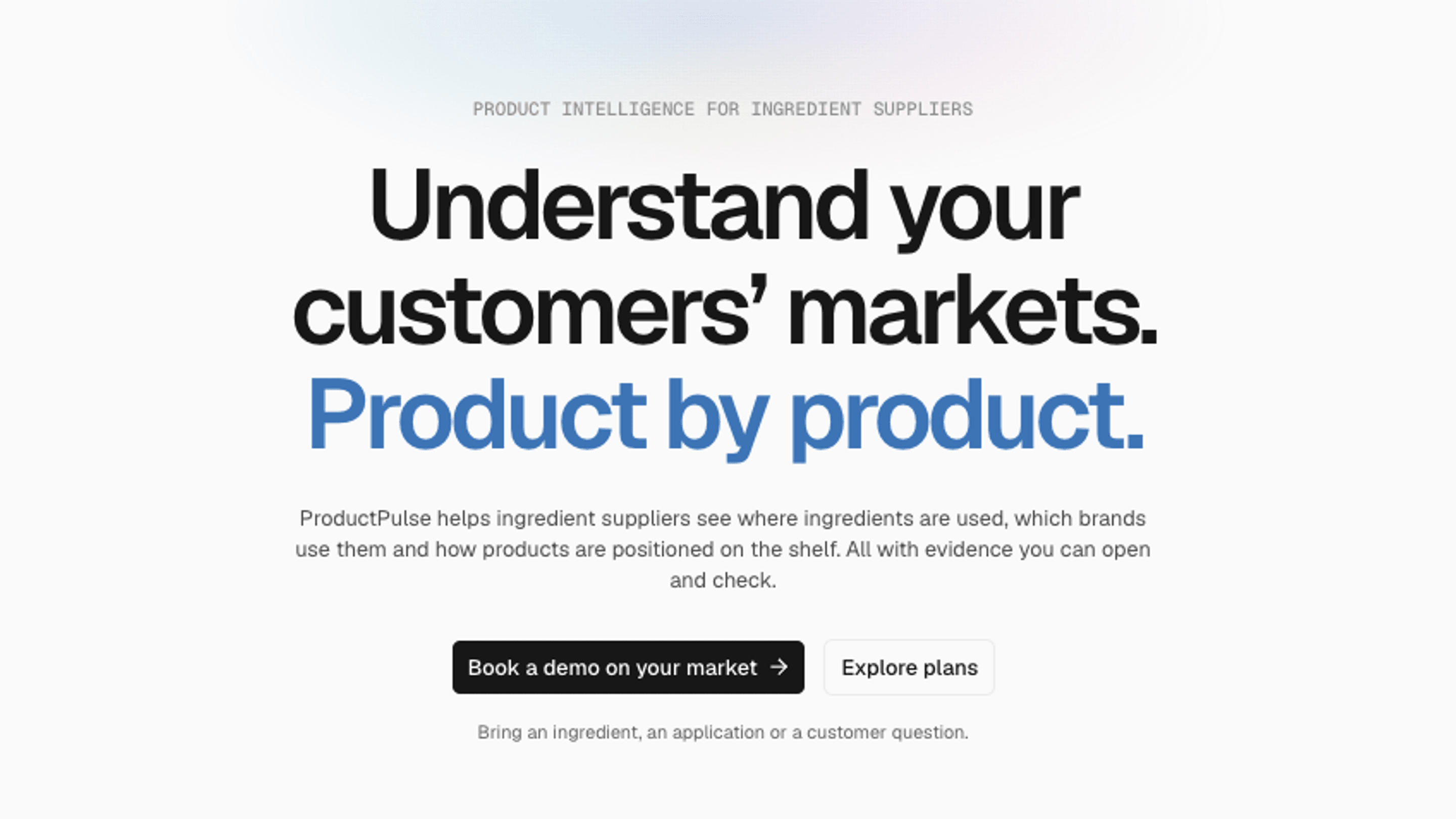
An ingredient supplier’s market extends into the products its customers make. Understanding that market means knowing where ingredients appear, which brands use them and how the resulting products are positioned.
This information is often scattered across retailer websites, product labels and internal research. A sales team preparing for an account meeting may need examples from a specific application. A market intelligence team may need to compare ingredient use across categories or countries. Finding and organising the relevant products can take considerable manual work.
Hammer’s ProductPulse platform is built around a large database of consumer products. It brings together product information from retail, wholesale and public catalogues, helping food ingredient suppliers explore ingredients, categories, brands and available shelf prices. The ProductPulse website introduces this approach through an interactive example, with fictional products and labels clearly identified.
The aim is practical: help commercial and market intelligence teams understand their customers’ markets and bring relevant evidence into decisions and conversations. The website presents a three-step workflow: define your market, ask a sharper question and follow the evidence.
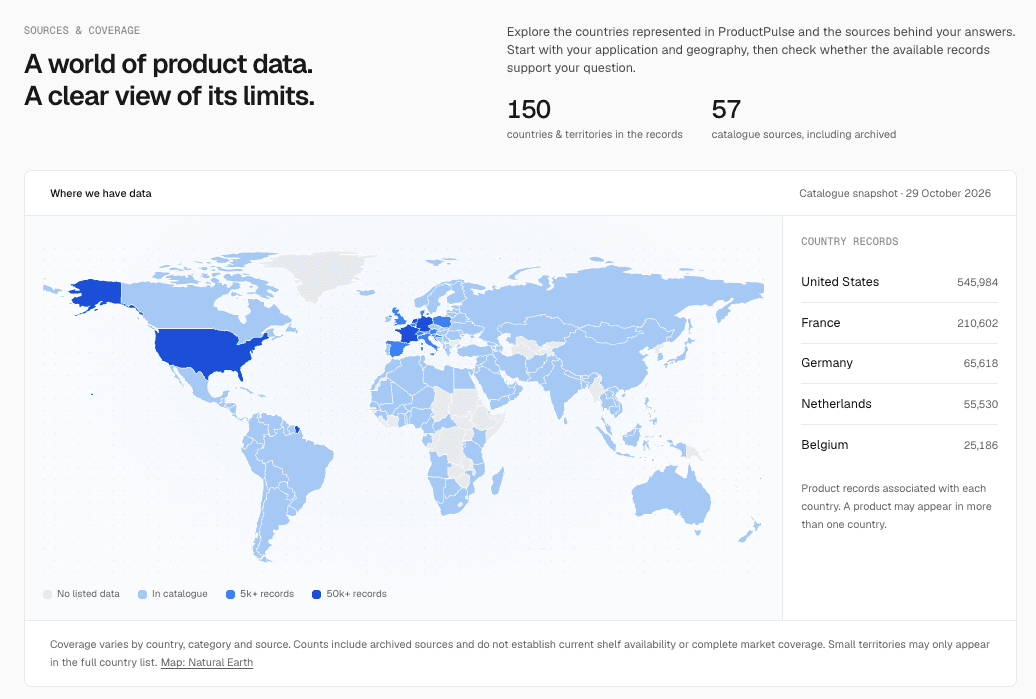
A taste of the database behind ProductPulse: the landing page’s coverage map shows where records are represented. Coverage varies by country, category and source; the map is a dated catalogue snapshot.
Key insights
- Explore ingredient applications: search recognised ingredient names across languages, combine ingredients or exclude alternatives within a selected market.
- Identify relevant brands and accounts: connect product evidence with brands and, where reviewed ownership information is available, the companies behind them.
- Compare product positioning: explore assortments and available shelf prices within a defined category and geography.
- Inspect the evidence: see which product records were counted and why, then check the original ingredient declarations and source references.
- Follow recent discoveries: find products first observed within a selected period, with source coverage taken into account.
Start with a commercial question
ProductPulse grew out of Hammer’s own market intelligence work. Detailed questions about ingredient use in narrowly defined applications required a way to examine product information at scale.
For an ingredient supplier, the starting point might be fibre use in Dutch breakfast cereals, protein combinations in snacks or coating ingredients in prepared foods. The website illustrates the cereal question using inulin, oligofructose and chicory-root fibre. The useful market is defined by the question the team needs to answer.
Start by choosing an application, country and channel, as described in the website’s “Define your market” step. Retail and cash-and-carry channels can be considered separately. Begin with a focused selection, then widen it as the question develops.
Understand where ingredients are used
The same ingredient can appear under different names across languages and product declarations. ProductPulse maps recognised ingredient names to a shared vocabulary, making it possible to search across those variations.
Users can also combine ingredient conditions. A team could look for products containing a selected fibre alongside a protein ingredient, or exclude a named ingredient from a selection.
The results provide examples of applications already represented in the recorded assortment. Researchers can inspect the original ingredient text to understand the match and assess its relevance. These observations can guide further commercial or technical investigation; functional suitability still needs application expertise and testing.
Move from products to relevant companies
For sales teams, ingredient research becomes more useful when it leads to an informed account conversation.
ProductPulse groups matching products by brand. Where sourced ownership information has been reviewed, it also connects those brands to potential target accounts. A commercial team can investigate an account’s recorded applications and prepare specific examples before making contact.
The relationship matters. A brand owner is a useful starting point, but it does not necessarily identify the factory, contract manufacturer or ingredient buyer. ProductPulse keeps those distinctions visible so that teams can decide what needs further research.
Compare positioning and inspect the products behind an answer
Available shelf prices add context to the product selection. Prices can be compared per kilogram or litre where the underlying pack information supports that comparison. Product records can also include images, descriptions, nutritional values and ingredient declarations, depending on what the source provides.
For more specific questions, the Ask workspace turns a plain-language brief into an analysis plan that users can review before running it. The classifications and summaries remain connected to the underlying products, including the reasoning and ingredient evidence behind a match.
That connection is central to ProductPulse. A result becomes more useful when the team can examine its scope, review examples and understand where the evidence is incomplete. Counts describe observed product records within the selection. They do not directly measure sales, ingredient tonnage or consumer demand.
From an initial question to ongoing market understanding
ProductPulse currently supports product exploration, ingredient combinations, brands and reviewed accounts, shelf-price snapshots and recently observed products. The website separates these capabilities from development priorities such as ingredient-use trends, reformulation tracking, regular digests and easier briefs.
The next articles in this series explain how to move from an ingredient question to a potential account shortlist, how to compare a category, and how the platform is intended to develop.
Explore the ProductPulse website to follow an illustrative ingredient-to-account workflow. Compare plans for Shelf Data, Market Intelligence and Analyst Retainer, or request a tailored demo on your own market. Bring an ingredient, an application or a customer question. We will get back to you.
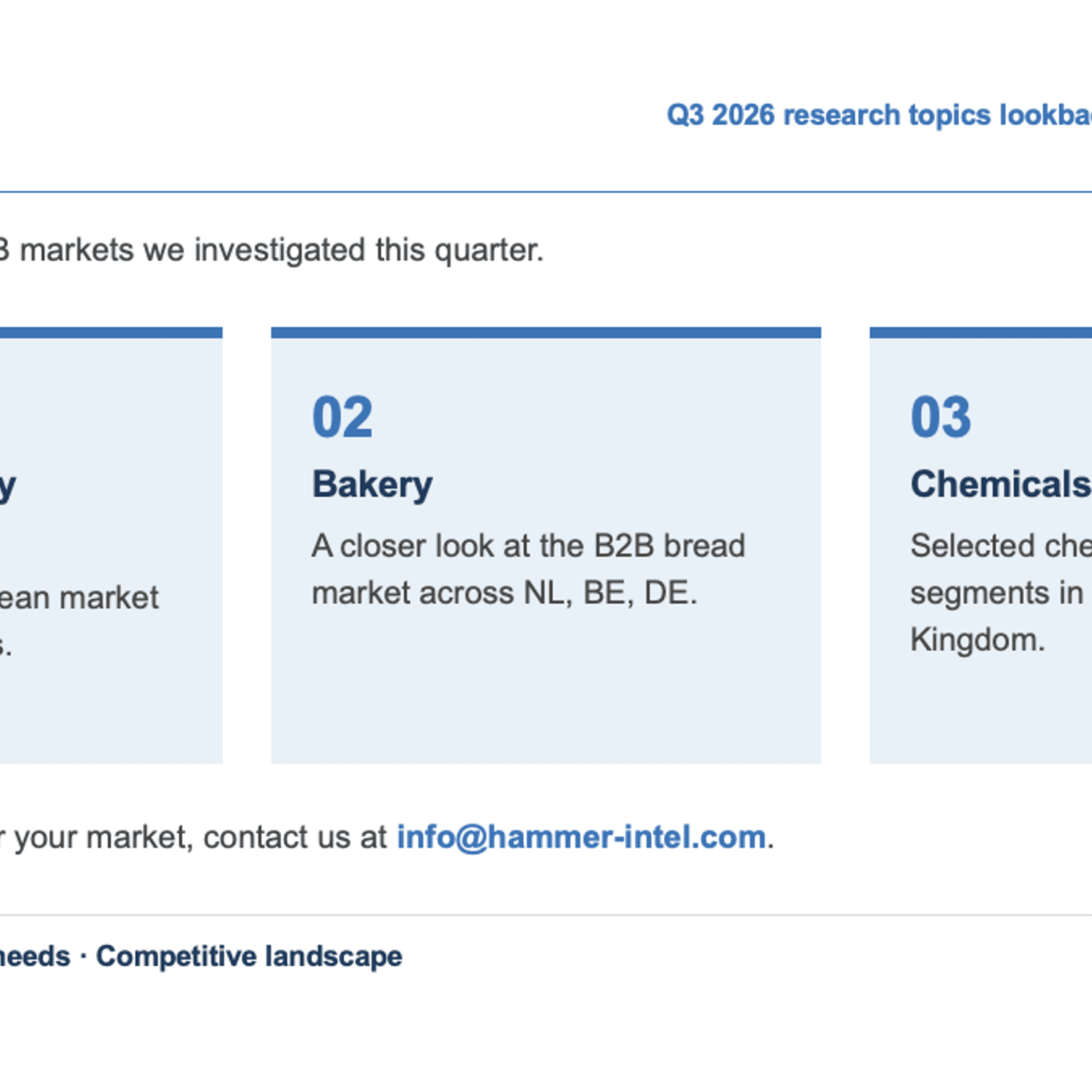
Markets we explored in Q3 2026
Freek Hens
30 Oct
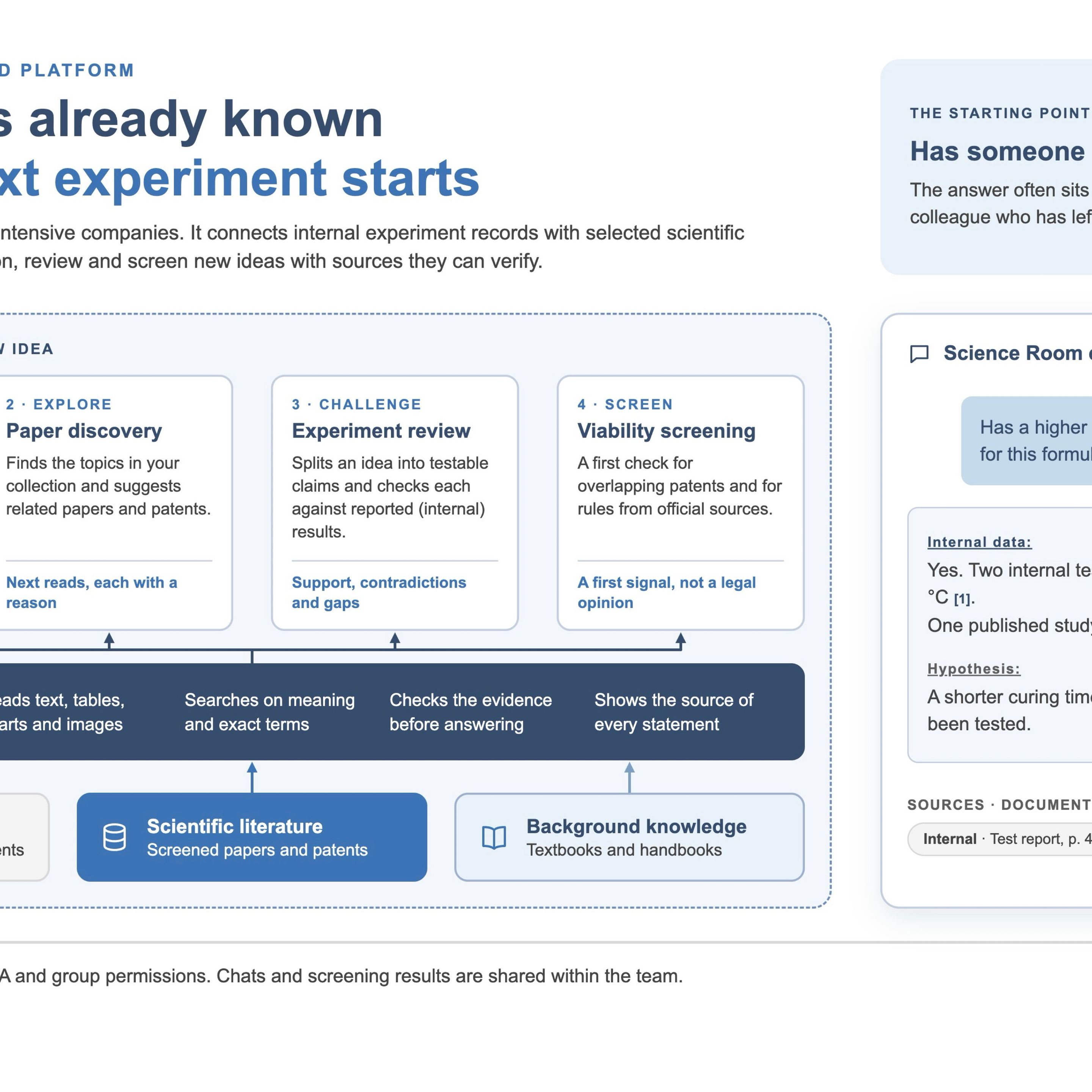
Hammer R&D Platform | Build on what your organisation already knows
Freek Hens
19 Oct

How Data Science is Revolutionizing Market Intelligence | 6 Game-Changing Uses

Tom Beckers
24 Jun 2025

Hammer ProductPulse | Uncovering the Retailer Landscape
Tom Beckers
10 Jun 2025