Article
Hammer R&D platform | Build on what your organisation already knows

Freek Hens
Data Scientist
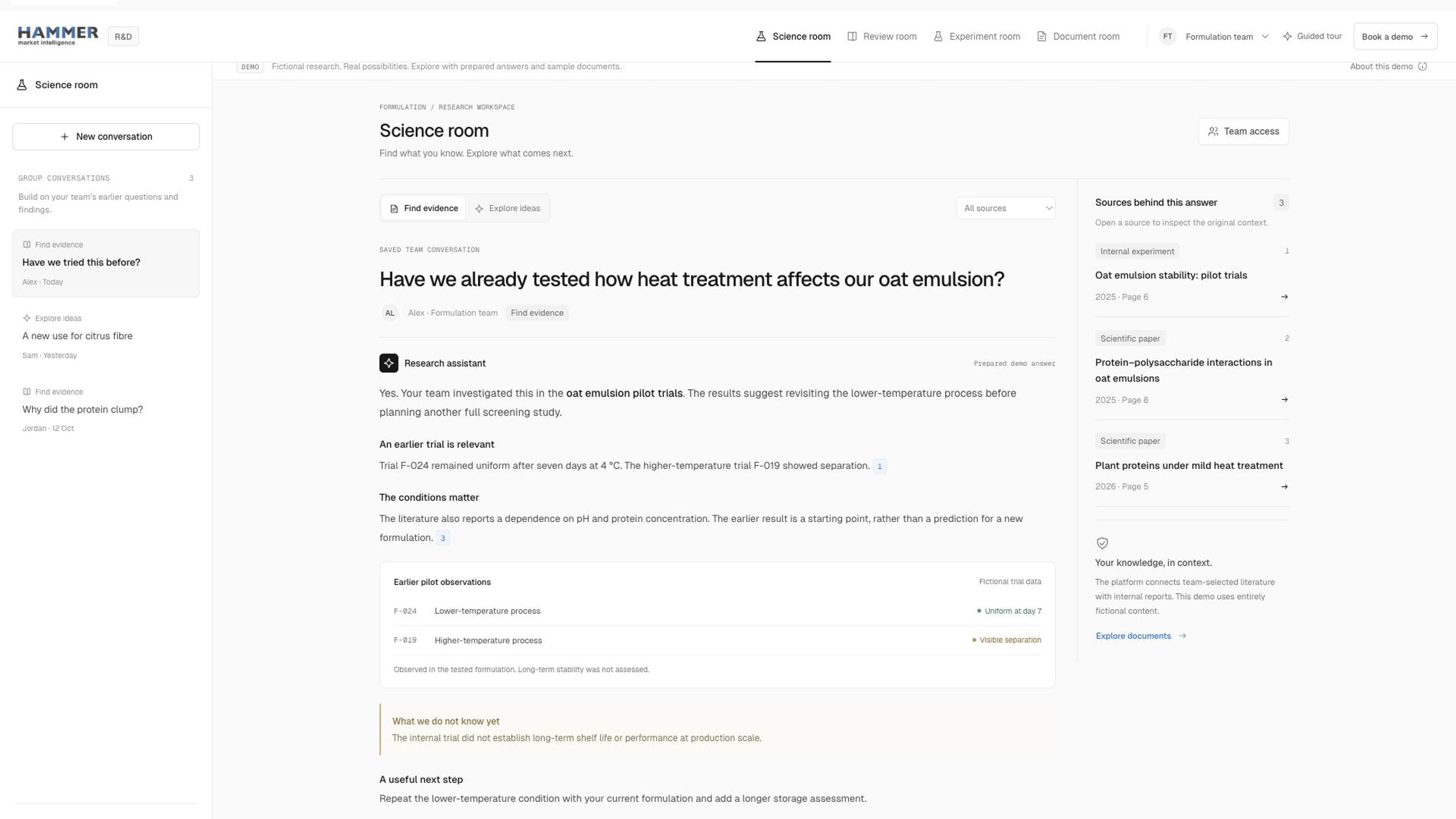
The Science Room connects research questions with earlier findings and their sources. All screenshots show the interactive demo, using fictional data and prepared answers.
Innovative companies invest heavily in research and experimentation. Each project adds knowledge: which formulations worked, which conditions affected performance and which approaches were abandoned. Over time, this becomes a substantial collection of reports, measurements and observations.
When a new idea emerges, it is not always clear whether part of it has already been investigated. The colleague who remembers an earlier experiment may have moved on. A relevant finding may be buried in a report from another project. Establishing what the organisation already knows can become a research task in itself.
Hammer’s R&D platform helps research-intensive companies make this accumulated knowledge accessible and use it to develop new ideas. Available to teams and organisations, it connects internal experiment reports with a user-selected collection of scientific literature. Researchers can investigate previous findings, explore possible applications and assess proposed experiments in a shared environment.
You can explore the platform in our interactive demo. Open a saved research conversation, inspect its sources or try a prepared experiment review. The demo uses fictional documents and answers to illustrate the workflows.
Key insights
- Retrieve earlier research: Ask questions across internal reports and selected literature to find out what has already been investigated.
- Explore new ideas: Interpret scientific findings in relation to proprietary research, with documented evidence and new hypotheses presented separately.
- Expand the research collection: Discover relevant papers based on the topics your team is investigating.
- Screen proposed experiments: Check the underlying assumptions against existing research before committing laboratory time.
- Identify potential patent overlaps: Flag relevant patents and questions that warrant specialist review.
- Work within a controlled environment: European-hosted infrastructure, Mistral AI and group-based access support collaboration around proprietary knowledge.
Finding what has already been researched
For companies running many experiments, remembering the details of previous work becomes increasingly difficult. Even when reports are well organised, a new question may cut across several projects, materials or applications.
The platform’s Science Room allows researchers to ask questions across their internal documents and uploaded scientific literature. A team could investigate whether a particular ingredient has been tested before, under which conditions it performed well and what limitations were recorded.
Relevant information often sits outside a report’s main text. The platform combines text recognition, table extraction and visual analysis to make findings in tables, charts and experiment images available for retrieval.
Answers include references to the underlying documents. Researchers can inspect the original evidence and judge whether an earlier result applies to their current question. This helps teams build on previous work and identify when revisiting an experiment would add useful knowledge.
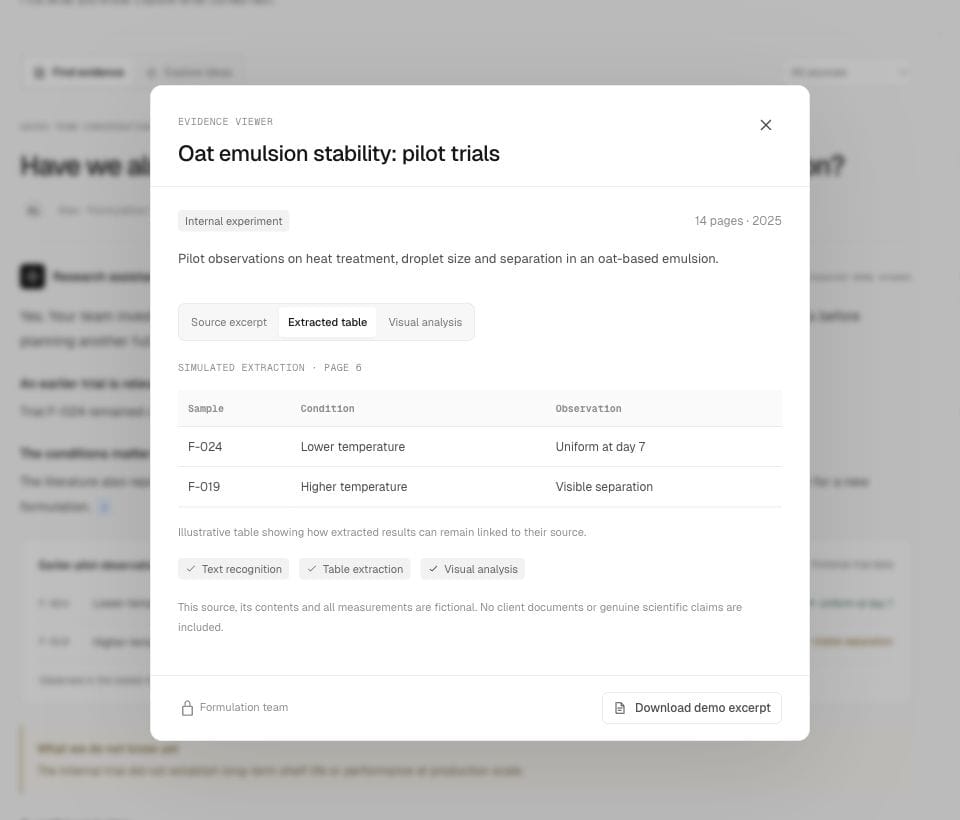
Inspecting the evidence: an illustrative extracted table remains linked to its source document.
Connecting scientific literature with proprietary knowledge
Scientific publications offer a broad range of findings, but understanding their relevance to a company’s own products and processes requires interpretation.
The platform works with literature uploaded by users. The team selects and screens the material for relevance and quality, creating a research collection with a known basis. Internal reports add the company’s own observations and experience.
Researchers can explore these sources together. A mechanism described in a paper might help explain an unexpected internal test result. A finding from another application might suggest a different processing condition or a new direction for development.
The platform supports this brainstorming by distinguishing documented findings, supporting background knowledge and inferred applications. Researchers can see which parts of an answer are grounded in the collection and which remain hypotheses to investigate.
Proprietary documents are processed within the platform’s configured infrastructure and AI services. European hosting and Mistral AI form the basis of this setup, without calls to OpenAI or Claude. Internal experiment content is not included in external paper recommendation or patent search requests. Patent screening does use the submitted idea and derived search terms, so teams should choose the level of detail they submit accordingly.
Discovering papers worth reading
A research collection continues to develop as new questions arise. The platform identifies topics within the uploaded material and suggests related scientific papers, with an explanation of their potential relevance.
This gives researchers a focused starting point for further reading. They can assess recommended publications and decide which belong in the team’s collection. External recommendations remain separate from the uploaded evidence until the team reviews and adds them.
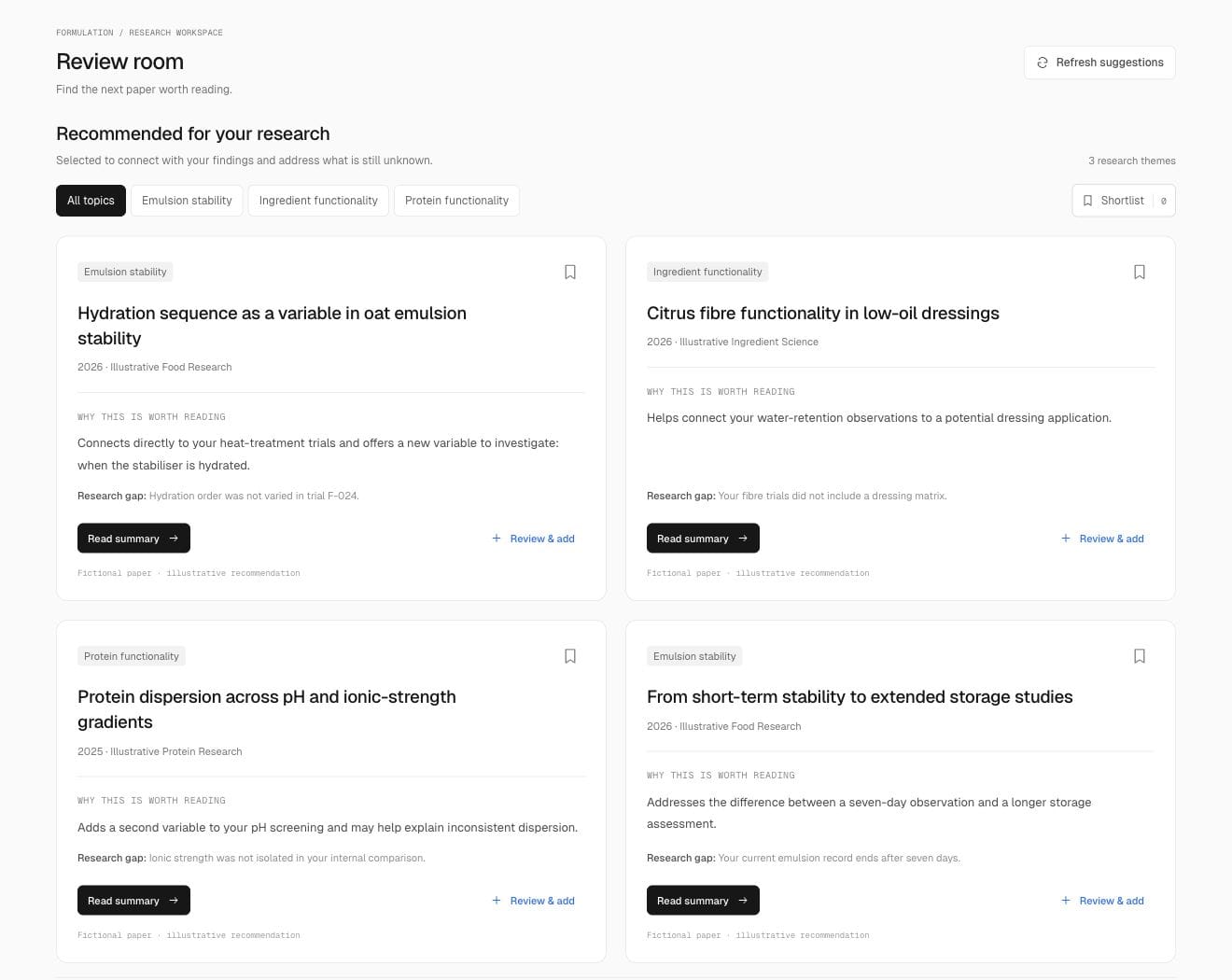
Paper suggestions explain their relevance to the team’s existing work and highlight questions still worth investigating. Publications shown here are fictional.
Reviewing a proposed experiment against the literature
Before an experiment reaches the laboratory, it usually rests on several assumptions. A material is expected to remain stable, a mechanism should produce a particular effect, or a process is expected to work under specified conditions.
The platform breaks a proposed experiment into testable claims and reviews them against the available research. It highlights supporting findings, contradictions and areas where evidence is missing.
For example, the literature may support a process at one temperature while providing little evidence for the conditions the team intends to use. An internal experiment may reveal an additional limitation. Together, these findings help researchers refine the proposed test and define what it needs to establish.
The review supports experimental planning. Its conclusions depend on the available documents and still require scientific judgement and practical validation.
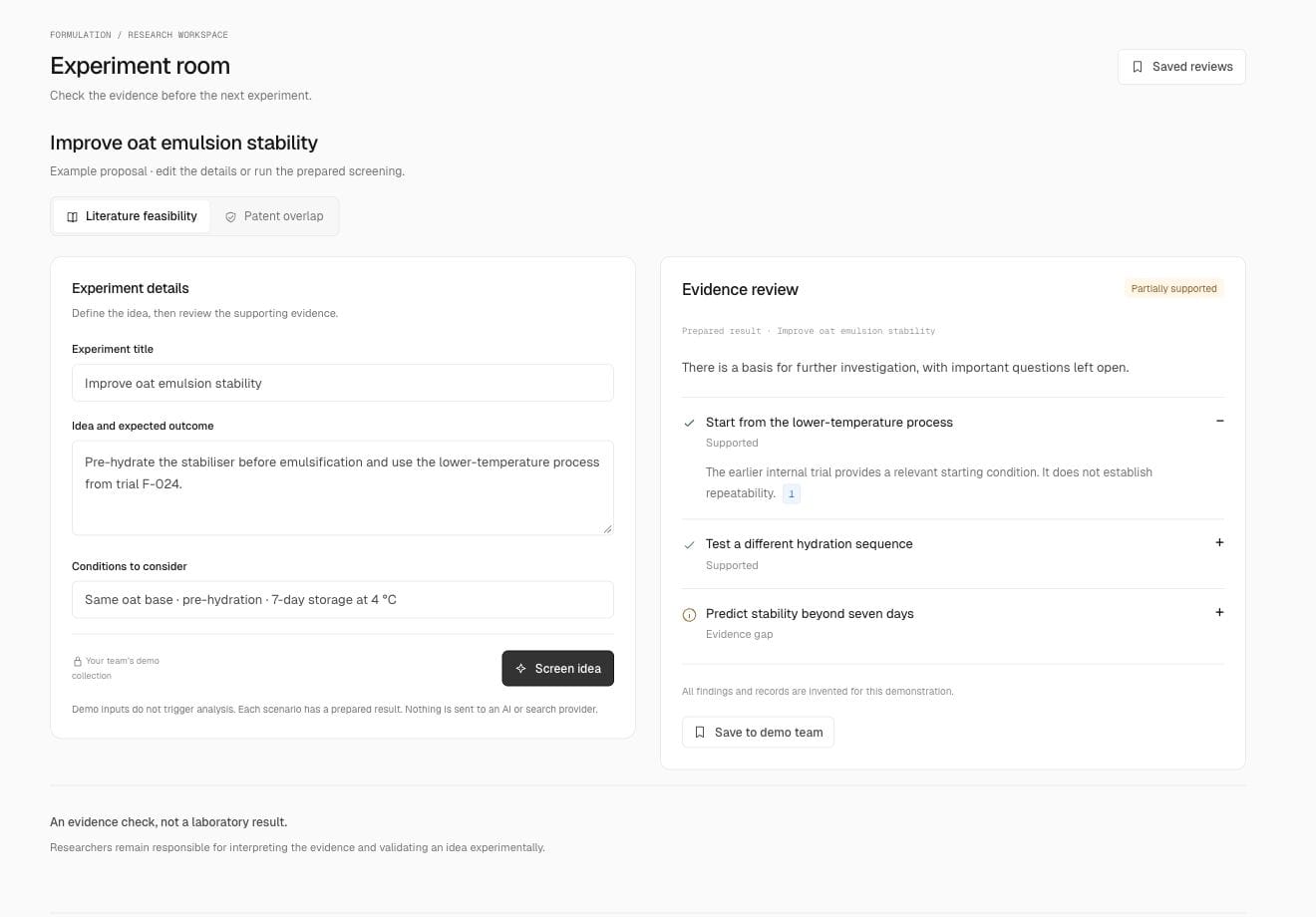
An example literature review separates supported assumptions from questions the proposed experiment still needs to answer.
Spotting potential patent overlaps
Promising ideas also need to be considered in relation to existing patents. The platform offers an initial screening of proposed ideas to identify potentially relevant patents and overlapping technical features.
This helps teams recognise issues early and prepare a more focused discussion with a patent specialist. The screening provides indications for further investigation; it does not establish infringement or freedom to operate.
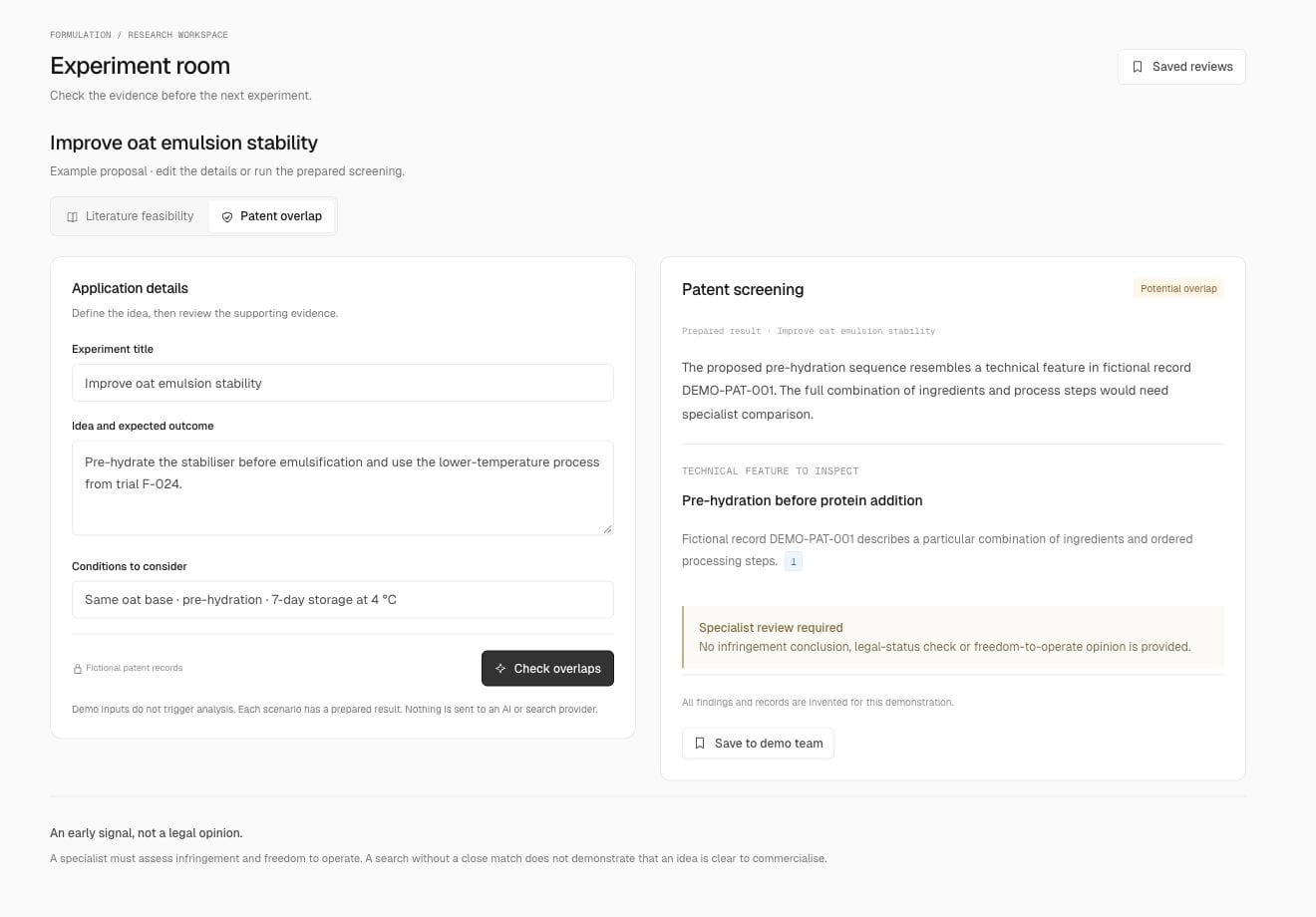
Initial patent screening highlights a technical feature for further review. The patent record and screening outcome shown here are fictional.
A platform for your R&D organisation
Research conversations and screening results can be shared within teams, allowing colleagues to revisit findings and continue earlier investigations. Group-based permissions control access to shared work.
Hammer offers the platform to research-intensive companies that want to make better use of their accumulated knowledge. Your team’s literature and internal reports provide the foundation, supporting both the retrieval of earlier findings and the development of new research directions.
Explore the interactive R&D platform demo to see how these workflows fit together. To discuss a platform for your own team or organisation, contact Freek at Hammer.